Thursday, August 13, 2009

A Bay Window


I have always deeply enjoyed the work of Edwin Lutyns and CFA Voysey.

Recently I was asked to design a bay window for a hipped roof stucco ranch.

My client wanted to create a very special, whimsical feel to her office retreat.

H
earing this. I took the opportunity to go immediately to Edwin Lutyens design of "Goddards". The result was delightful.
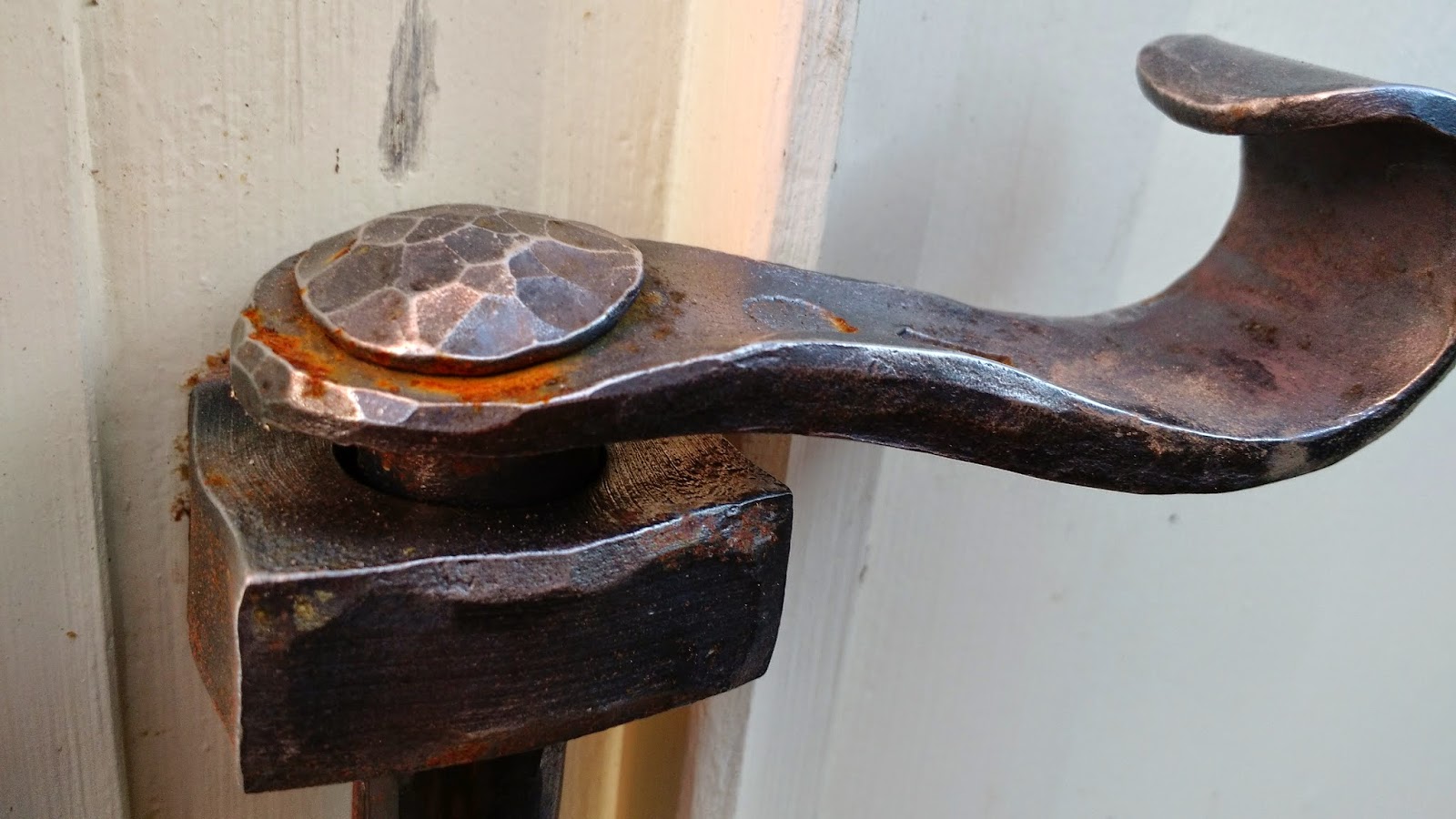


These were the pictures I was working from as I changed what was made of brick and stone to beautiful douglas fir.


Exterior....


Interior...

The interior walls of the bay were extended to create the end panels of bookcases These again were douglas fir. I carved a large trillium in the upper left and right hand panel.


... a lot of fun.

H
ere's what it looks like installed.


A view from outside (not yet fully painted).


Tuesday, April 07, 2009

A Remote Spirit Lodge

Some years ago I became involved in a joint venture between Ecotrust and the Haisla First Nation in an unusual venture to preserve a quarter million acres of virgin Pacific Northwest rainforest. This adjoined an existing three quarters of a million acres of preserve that would be returned to the protection and management of the Haisla First Nation.

They wanted to build a structure on a remote bench of land that was the gateway to that wilderness.

The geography of that area is snow capped, mountainous, deeply incised by profound indigo salt water fjords. These fjords penetrate a hundred miles into the mountain system. Mountains rise sheer from the deep waterways dripping boisterous waterfalls, cloaked in mossy spruce and cedars and dramatic ice polished granite faces hundreds of feet tall.

The topography is vertical.

At the mouth of the Kowesas River valley is a small unusually flat rock shelf. This was to be a staging area and entry for logging operations in that valley.

Ecotrust approached me to talk about the feasibility of building a small cabin on that shelf. There the Haisla could use to lay claim to their ancestral homeland and possibly thwart logging development.

I responded that I would be delighted to be involved in such a project and that I would like the structure to be something that would be a statement of the deep spirit of the Haisla Nation.

And so I began three of the most wonderful and difficult summers of my life.


Logistics were a significant hurdle. The Kowesas River Valley was a three hour jet boat ride from the end of the road. The only other access was float plane. That was how I arrived at the beginning of the season with my plane load of tools.


The first summer we established a construction camp. There was already a trapper’s cabin there that three or four of us shared with a city of mice and a pine martin with a lot of attitude.


Two Haisla men, Frank and John, became the mill men. They got into a jet boat early every morning with chainsaws, raingear, my cutting list, and peanut butter and jelly sandwiches. They went to nearby river bars and milled all log posts, spectacular beams, other lumber supplies. They returned at the end of the day with my next days construction supplies in tow.


Back in camp, we had a cook, George, who kept our bellies full and our morale high. He also lent his back to the construction. We had a supply boat arrive every two weeks and it brought food, fuel, mail, volunteers, and clean laundry.

This is what we got built in the first three months.

The foundation is 15 laid granite columns and one existing boulder.

The posts are whole logs averaging two feet in diameter, cut to fit the irregular stone bases. A steel rod pins the center of the post to the foundation.

The tidal range there averaged fifteen feet and that diurnal lift was crucial to our ability to move huge logs and beams. We also had a large supply of winches, come-alongs, snatch blocks, and line.

The posts are cut halfway up in an unusual joint that allows the floor beams to pass through them with a “Lincoln Log” type joint. The upper half of the post is replaced, straddling the joint.


The structure is traditional mortise and tenon construction pinned with 1” oak pins. No bolts, no nails.


The exterior walls are slabs of clear old growth Red Cedar 2” thick, averaging 2 feet wide and 9 feet tall placed in a slot in the bottom sill and stopped to the underside the overhead beam. We battened between the slabs.

The roof was raftered on two foot centers with rafters 4”x20” then sheathed with 1 by cedar, two inch rigid insulation and steel roofing.

We anticipated a 12’ snow load.

All doors and windows and furniture were built there.

The Kowesas lodge was a significant life event for many of us who worked on it. It was a monument to the efforts of the Haisla. We built something together that was so much bigger than what any of us could do on our own, both physically and spiritually.

It is always spiritually renewing to create such beauty. For many it was one of the few experiences of that they had.

The Haisla Nation declared that this wilderness area would be alcohol and drug free and so for many who lived and worked there it was a very important opportunity to enjoy long term sobriety while living in an extremely beautiful and creative place.


Upon completion the Haisla celebrated with a massive feast, a three day salmon barbecue, with ceremonies and traditional dancing, chanting, carved masks, button blankets and magical carved rattles late into the night.


The Lodge still stands.

The Kowesas valley remains wild, rich in wolf packs, grizzly bears, and big beautiful trees.

.


Wednesday, December 17, 2008

An Art Studio For Patricia


Patricia is an artist in many media although glass & fiber occupy her primarily. She is a constant creative delightful person. When we first met she told me she wanted to recreate her longtime home into an artspace inspired by spirit and whimsy. The original house had become, for her, profoundly dreary - a northwest ranch style built in the mid seventies.


Working together, we designed an upstairs studio with a second floor porch large enough for her to comfortably install her harness loom, all sheltered by a large dramatic sweeping new roof.


On the south we designed and built a large array of arched topped windows.


At a later date Patricia plans to create glass panels that fit into these frames.


T
he doors onto the porch and the porch ceiling itself also have the same characteristic re curving form. In clear vertical grain fir they ar
e stunning. Seen from the outside the upstairs windows were combined with the lower level studio window array to create a single effect.


Downstairs the garage got a new array of windows on the south wall, and an entry area that allows for a stairway up to the studio and a newer all glass overhead door. The garage turned studio will be used for wet work like felting.


Patricia teaches quite a lot and so these studios were designed to be accessible without entry into her home.

On the outside, seen from the west, the upstairs covered porch roof sweeps down to a gracefully curved termination. The trellis for the living room gives the roof line one last bounce.

Here are a few more views of this project:


Thursday, March 23, 2006

Inside and Outside


Table, Cabinets


The table shown above was designed around a single plank of honduras mahogany. Its lower structure is quartersawn white oak. It is entirely traditionally constructed with mortices and tenons. At the far end is a small sink.

The cabinets below are from a kitchen I designed and built. They are southern longleaf yellow pine with a complex multiple glaze finish. The wall paneling in the background is of the same material. The countertop is of carrera marble.

Tuesday, March 21, 2006

Winery Entry


This entire entryway is new to this barn. The timberframe work was constructed of fir beams salvaged from an old drydock in Astoria. The cant of the entryway roof matches the barn's roof. The columns and wall behind are stucco. The door, 9' high , 4' wide, and 3" thick, is of quartersawn white oak. This is the same material the hundreds of french wine barrels behind it are made of.


I designed the handrail below as a part of the overall interior design. My good friend and blacksmith, Arnon Kartmazov forged it. The railing is bronze and the ballusters are stainless steel.